Notes
The Problem With Fast Fashion Isn’t Just Sustainability
The environmental cost of fast fashion matters. So does its quieter effect on how we buy, wear, and value what we own.
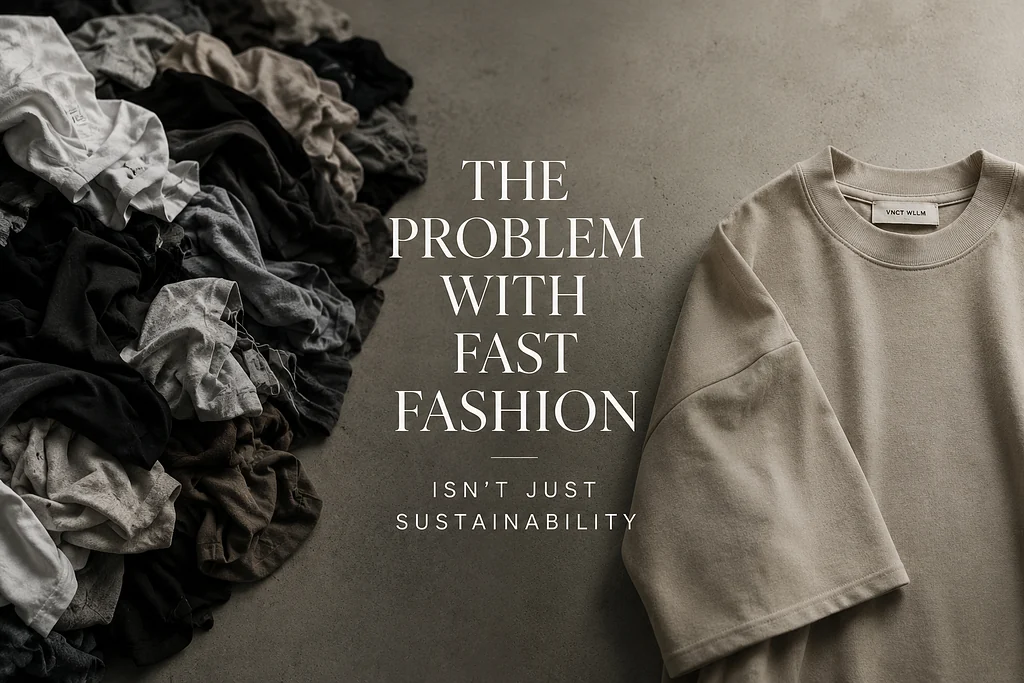
Most criticism of fast fashion begins with its environmental and human cost. The industry produces clothing at enormous speed and volume, placing pressure on natural resources, waste systems, and the people working throughout its supply chains.
These concerns deserve serious attention. Yet fast fashion has also caused a less visible change. It has altered the way we think about clothing itself.
We once expected garments to remain with us. A coat was bought with several winters in mind. Denim softened and changed through wear. A familiar sweater might lose some of its original shape, but gain a place in the owner’s life.
Clothing did not need to remain pristine to retain its value. Use gave it meaning.
Fast fashion encourages a different relationship. Garments are increasingly treated as temporary, often before they have reached the end of their physical life. The problem is not always that the clothing can no longer be worn. It is that the wearer has already been encouraged to move on.
New collections arrive constantly. Trends emerge and disappear within days. Social platforms reward whatever has appeared most recently, while recommendation systems place the next purchase in front of us before we have had time to understand the last one.
The result is a culture in which clothing can feel old after only a few wears.
We buy clothes, but do we still build wardrobes?
A wardrobe should develop gradually. Its pieces should relate to one another and reflect the life of the person wearing them. Some garments serve a practical purpose. Others are chosen for their cut, material, or the feeling they create. Over time, the wardrobe becomes more personal because its contents have been selected, worn, and kept.
Fast fashion interrupts that process.
Instead of building a wardrobe, we accumulate purchases. A garment may be bought for a particular event, a passing trend, or a single photograph. It enters the wardrobe without a clear relationship to what is already there. Soon, another item takes its place.
This does not always look like waste. The garments may remain folded in a drawer or hanging untouched. They still exist, but no longer hold our attention.
That distinction matters. A disposable wardrobe is not defined only by what gets thrown away. It can also be defined by how quickly we stop caring.
When novelty becomes the main reason to buy something, the garment’s value begins to decline as soon as it is purchased. The excitement belongs to the transaction rather than the experience of wearing it.
Building a wardrobe requires a different kind of attention. It asks whether a garment will still feel right after the moment that introduced it has passed. It asks what place the piece will occupy and how often the owner will genuinely return to it.
These are simple questions, but the speed of modern fashion rarely leaves much room for them.
Fashion needs change, but it also needs time
Fashion has always moved. Its evolution records changes in culture, identity, technology, and craft. Experimentation is essential, and clothing should never be reduced to a fixed set of supposedly timeless basics.
The difficulty lies in the present rate of acceleration.
When the cycle moves too quickly, there is little time to distinguish a lasting idea from a temporary signal. Designers face pressure to produce novelty on schedule. Consumers face pressure to respond before the next trend arrives. Clothing becomes content, and content must remain in motion.
Slower fashion does not require design to become static. It allows an idea enough time to be considered, developed, and worn.
A sculpted silhouette can feel contemporary without belonging to one short season. A distinctive garment can carry a strong point of view without losing its relevance once a trend recedes. Permanence does not mean designing clothes without character. It means creating character that can survive repeated encounters.
That requires restraint.
Restraint is often misunderstood as minimalism or simplicity. It is neither. A restrained design may still be expressive, unusual, or technically ambitious. The restraint lies in knowing when the idea is complete. Nothing is added simply to create another variation, fill another release window, or satisfy the demand for constant output.
Producing fewer garments gives each one more responsibility. Every piece must justify its presence.
Permanence has become a form of luxury
Luxury is often presented through price, scarcity, or material. There is another form of luxury that receives less attention: the ability to take time.
Time to develop a garment rather than rush it into production. Time to consider proportion, structure, and how a piece behaves when worn. Time for the wearer to return to it repeatedly and form a relationship with it.
This kind of permanence does not mean that a garment must last forever. Very little does. It means the garment was conceived with a life beyond its launch.
A piece designed beyond seasons does not depend on constant explanation. It does not become irrelevant when the campaign ends or the retail calendar advances. Its identity remains intact.
The same principle changes how we understand ownership.
A meaningful garment is rarely the one that attracted the most attention on the day it was bought. It is the one repeatedly chosen afterward. It becomes familiar through movement, routine, travel, work, and occasion. It earns its place by being worn.
That is difficult to measure, which may be why the industry speaks about it so rarely. Sales can be counted immediately. Familiarity takes years.
Choosing better begins with paying attention
Calls to “buy less” can sound moralizing, especially when they ignore differences in income, access, sizing, and daily need. Not every purchase can be an investment piece, and responsibility cannot sit with the consumer alone.
Still, all of us can pay closer attention to why we want a garment.
Would we choose it without the urgency of a limited drop? Does it work with what we already own? Are we interested in wearing it, or only in acquiring it? Can we imagine returning to it after the current season has passed?
The aim is not to create a perfect wardrobe. It is to build a more deliberate one.
For designers, the questions are equally direct. Does the garment contribute a clear idea? Has it been given enough time? Would it still deserve to exist without the demand for another launch?
Not every design needs to be permanent. Fashion has room for play, provocation, and brief cultural moments. The problem begins when disposability becomes the default and considered design becomes the exception.
Clothing should have a life after its release
The conversation around fast fashion must continue to address production, waste, resources, and labor. But quantities and impact reports cannot fully explain what the industry has changed.
Fast fashion has trained us to confuse newness with value.
Recovering a more considered relationship with clothing begins by separating the two. A garment can remain desirable after it stops being new. It can become more personal through repeated wear. It can hold its identity while the season changes around it.
This is the difference between purchasing clothes and building a wardrobe.
The future of fashion may depend less on finding an endless stream of new things and more on recognizing what deserves to remain. Designers can create with greater patience. Wearers can choose with greater intention. Garments can be given enough time to become part of a life.
Clothing should not need to disappear quickly to make room for what comes next.
Some pieces deserve to stay.
Further reading — Why the Name Remains
Back to the Journal